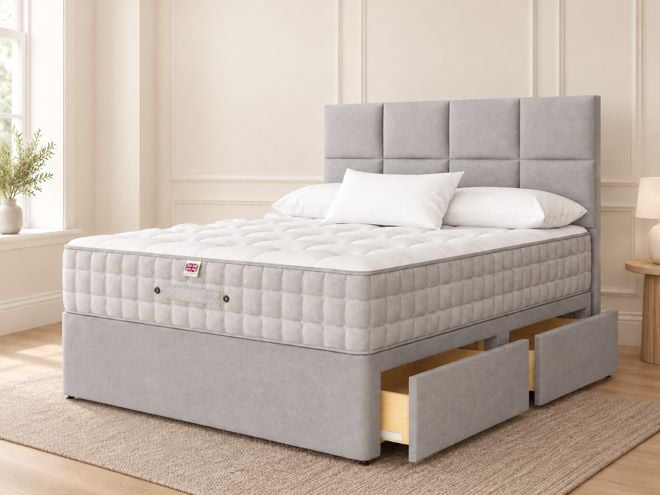
What makes a mattress suitable for a heavier sleeper?
Three things matter: the strength of the support core, the depth of the comfort layer, and the construction of the edges. Heavier sleepers press harder into a mattress at every point, which means a unit with too few springs (or springs with light-gauge wire) will lose its shape sooner. A deeper comfort layer cushions the points that take the most weight: the hips, shoulders and lower back. Strong edges keep the mattress feeling the same size after years of getting in and out of bed.
Pocket springs and how many you need
A pocket sprung mattress with a higher spring count generally suits heavier sleepers better. Look for 1,500 pocket springs and upwards in a king size; 2,000 to 3,000 is common in higher-end mattresses and provides a more responsive, body-zoned support. Open coil mattresses can also work but tend to wear out faster under heavier loads.
Firmness for heavier sleepers
Lighter sleepers can get away with softer mattresses; heavier sleepers usually can't. A medium firm or firm tension keeps your spine aligned by holding your weight up rather than letting it sink. Soft and medium-soft mattresses will feel comfortable for the first few weeks then start to sag, particularly along the centre of the bed. If you sleep with a partner who's lighter than you, a zip-and-link mattress lets each side have its own tension.
Edge support matters
Most heavier sleepers want to use the full surface of the mattress, including the sides. Look for mattresses described as offering edge support, where the perimeter springs are reinforced. This stops the edges from collapsing when you sit on the bed to put socks on or get out in the morning.
Sizes for heavier sleepers
If two heavier sleepers share a bed, a king size (150 x 200cm) or super king (180 x 200cm) gives each of you more room and reduces the wear on the centre of the mattress where the two of you meet. For a single heavier sleeper, the same applies in reverse: a double mattress gives more room to spread out, distributing wear more evenly.
How long should it last?
A well-built mattress for a heavier sleeper should still last seven to ten years, the same as for any other sleeper, provided it's well looked after. Rotate it every few months, use a mattress protector to keep dirt and moisture out of the fillings, and don't sit on the same spot day after day. If you can flip the mattress, do so once or twice a year.
Free next-day delivery and recycling
Order in-stock before 4pm and we'll deliver free of charge the next working day. Add our recycling service and we'll take your old mattress with us. If you're weighing up two or three options, call our sleep experts on 0333 577 5773. They can help you narrow it down based on your build, sleeping position and any aches you're trying to ease.